
'Due to rural stress, volumes continue to remain an issue for the industry, and we are yet to see any revival in demand.'

Brokerages expect India Inc to report an upturn in earnings for the March quarter of 2022-23, after a relatively muted showing in the previous two quarters. This growth is expected to be led by banking, financial services and insurance (BFSI) companies, FMCG firms, and automobile makers. The combined net profit of the Nifty50 companies (excluding Adani Enterprises) is expected to have grown 15.6 per cent to Rs 1.77 trillion in Q4FY23, from Rs 1.53 trillion a year ago.

The new push is being driven primarily by over 170,000 villages where household income is over Rs 1 lakh a year.

In a relief to FMCG major Dabur, two of its foreign subsidiaries, Dabur International and Dermoviva Skin Essentials, have been removed as a defendant in multiple lawsuits filed in a US court over allegations that their hair-relaxer products caused ovarian cancer, uterine cancer and other related health issues. However, lawsuits filed against its third international subsidiary Namaste Laboratories LLC, would continue before the US District Court for the Northern District of Illinois, according to a statement from Dabur on Wednesday. Dabur International and Dermoviva were removed and got relief in the multiple suits due to lack of jurisdiction as they have not either manufactured, marketed, distributed or sold hair relaxer products in the US, it added.

Discount retailer DMart (Avenue Supermarts) hit its highest levels in a year and a half last week and is up over 11 per cent in the last one month. The company depends on low operating costs to offer the lowest prices to consumers, which enables sales velocity and scale, further reducing costs. This virtuous feedback loop has helped DMart gain market share in a sector dominated by unorganised stores.

Baba businesses are sprucing up their act as they expand product portfolios and enhance brand image

British multinational BAT PLC on Tuesday said it plans to sell up to 3.5 per cent stake in India's ITC Ltd to institutional investors through a block trade. In a statement, British American Tobacco PLC (BAT), the single largest shareholder in ITC Ltd (ITC), said its wholly-owned subsidiary Tobacco Manufacturers (India) Ltd (TMI) intends to sell up to 43,68,51,457 ordinary shares in the Indian diversified entity to institutional investors by way of an accelerated bookbuild process (block trade), subject to customary closing conditions.

Top companies reported that despite most of them making staples and essential products, movement of raw material, goods and labour remained restricted, impacting sales.

Among Sensex stocks, Wipro gained the most by 3.29 per cent. Ultratech Cement, Reliance Industries, Hindustan Unilever, Nestle, NTPC, M&M, HDFC Bank, ITC, Kotak Bank and Axis Bank were among the winners. On the other hand, HCL Tech fell the most by 1.24 per cent. SBI, TCS, Infosys, IndusInd Bank and Tata Steel also dropped.

Sales of refrigerators were higher this year versus last year.

The issue of pollution caused due to the non-degradable material is keeping consumer goods majors - from ITC and Dabur to Nestl and PepsiCo - on their toes.
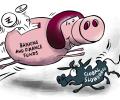
Even as banks and finance companies are reporting record-high earnings, their weighting in the benchmark National Stock Exchange Nifty50 Index has seen a downward trajectory. Investors expect a stronger performance from other sectors in the new year. Currently, banking, financial services and insurance (BFSI) companies collectively hold a weighting of 34.5 per cent, down from 36.7 per cent at the end of December 2022 and a record high of 40.6 per cent at the end of December 2019. This represents the sector's lowest weighting in the index since December 2021 when it stood at 33.7 per cent.

Growth numbers for the large players in the sector, though, improved during the quarter.

Lower income groups earning less than Rs 100,000 a year are yet to recover as are those earning between Rs 100,000 and Rs 200,000.

Sensex rises, Nifty holds 8,900; FMCG, Pharma shares lead.

Among the Sensex firms, State Bank of India, ITC, Nestle, Asian Paints, Tech Mahindra, Mahindra & Mahindra, Tata Consultancy Services and Hindustan Unilever were the major laggards. In contrast, HCL Technologies, Power Grid, Sun Pharma, NTPC, Bajaj Finance and Titan were the gainers.

Over the past year, Amul has undergone a transformative journey, evolving from a dairy-centric entity to a comprehensive foods company. Since 2022, PepsiCo India, too, has embarked on extensive launches in the food category. Not to be left behind, ITC, which has been introducing an average of 100 fast-moving consumer goods (FMCG) products across categories every year, has also launched a number of packaged food items.

Global IT firms are taking a cue from consumer firms, which revolutionised marketing tactics in the FMCG segment with the shampoo-in-a-sachet concept by appealing to semi-urban as well as rural consumers.

'Today's engineering graduates have to learn the skills to solve problems which is actually a higher order skill.'

The biggest bounce is in the realty sector, where the industry index jumped 80%. There's been a turnaround also in automobiles and ancillaries (up 45%). The pharma and health care indices have a welcome return of roughly 35%.

'What will matter in 2024 from the market standpoint is the direction of interest rates globally, as well as in India.' 'The results of the general elections will also be keenly watched.'

Foreign investors made a significant turnaround and injected over Rs 1,500 crore into Indian equities in February, reversing the massive outflows seen in the preceding month, primarily due to robust corporate earnings and positive economic growth. Additionally, Foreign Portfolio Investors (FPIs) continued to be bullish on the debt markets as they put in over Rs 22,419 crore during the month under review, data with the depositories showed. Looking ahead to March, the outlook for FPI flow appears promising, provided the current economic trajectory and corporate performance sustain their positive momentum, potentially continuing to attract foreign investment into Indian equities, Mayank Mehraa, smallcase manager and principal partner at Craving Alpha, said.

After a sharp fall in the share prices of HDFC Bank and other private sector lenders in the past three days, the BFSI (banking, financial services and insurance) sector weighting in the Nifty50 has slipped to a seven-year low of 32.03 per cent, down from nearly 36.6 per cent at the end of March 2023 and 34.5 per cent at the end of December 2023.

'We are confident that over the next few years the government will strike a fine balance between populist measures and growth, and manage coalition partners well.'

However, the government's draft policy on e-commerce companies has forced consumer companies to also adapt to the changes. For Dabur India, e-commerce channel continues to be a key driver of growth in urban India. The contribution of online sales to its entire portfolio is at six per cent compared to 1.5 per cent before the pandemic.

Thousands of small brands are ruling the consumer market despite the predatory pricing and deep discounting by foreign e-commerce companies and efforts of certain FMCG companies to sideline the distributor network, said the Confederation of All India Traders (CAIT), which represents about 70 million traders in the country. "If the government gives support policies to non-corporate sector and tighten the e-commerce companies to obey the policy and the law both in letter and spirit, the retail trade of the country is bound to blossom in pursuance of the vision of PM Narendra Modi for Make in India and Atmnirbhar Bharat," said CAIT national president BC Bhartia and secretary general Praveen Khandelwal.

ITC highlighted that legal cigarettes account for 9 per cent of tobacco consumption in India, but 80 per cent of tax collection is from tobacco products. While illicit cigarettes account for roughly one-third of the market share, legal cigarette volumes have recovered to around 96 per cent of peak FY13 volumes, after dipping to 70 per cent in FY21.

Salaries in India are expected to increase by 10.3 per cent in 2023, highest among major world economies and Asian peers, according to Aon plc. In 2022, salaries in India witnessed an actual increase of 10.6 per cent in 2022. As per Aon plc's 28th Annual Salary Increase Survey in India, double-digit salary growth will continue in India despite economic volatility, largely as a response to high attrition rates.

Of the 30-share Sensex, 13 ended higher, while 17 led by Power Grid, Tata Steel, Bajaj Auto, Hero MotoCorp, NTPC, Tata Motors, Dr Reddy's, M&M, GAIL, Infosys and L&T finished lower, fell by up to 2.40 per cent
Most market analysts are expecting the momentum to shift towards 'quality' and 'growth' stocks in 2024 after the outperformance of 'value' stocks over the past three years. 'Value' stocks are generally well-established companies with steady profits that are trading at a discount to what they are intrinsically worth. Companies in sectors such as commodities, industrials, commercial vehicles and public sector units (PSUs) fall in this bracket.

Indian stock markets are expected to be driven mostly by global factors this week amid a lack of local triggers and earnings season largely coming to an end, say analysts. Crude oil prices, rupee movement and US Federal Reserve meeting minutes to be released this week will also influence the market sentiment. "With the earnings season behind us, global cues would largely dictate the trend in the coming week," Ajit Mishra, SVP - technical research, Religare Broking Ltd, said.

Top losers include Hero MotoCorp, HDFC, SBI, Infosys, HCL Tech, ICICI Bank, Bajaj Finance, ONGC, Bajaj Auto and IndusInd Bank, falling up to 2.63 per cent.

Trinamool Congress is the second highest recipient of political donations through electoral bonds.

This is the Mukesh Ambani-led company's second entry into the dairy segment and it will directly compete with Amul and Mother Dairy.

They are evaluating realignment of warehouses and supply chains, besides exploring locations to set up hubs and shutting down some distribution centres

From anti-profiteering to affixing stickers on existing stocks, FMCG companies are bracing for new set of GST challenges

Operating margins have been the primary driver of corporate earnings in India in recent quarters, despite revenue growth suffering from weak consumer demand. Companies across sectors have reported a sharp improvement in earnings before interest, tax, depreciation, and amortisation (Ebitda) margins over the past two years, benefiting from lower commodity and energy prices. Higher margins more than compensated for slower revenue growth, resulting in double-digit growth in net profit for five consecutive quarters.

'As long as Amul was coming in with products it was not a problem because it was something value added and with a shelf life.' 'When it gets into the local market by procuring locally, it cuts into the market-share of local cooperatives.'
A hotel in 1975, entry into paperboards in 1979, India's dominant cigarette maker, ITC, read the tea - or tobacco - leaves early, leveraged its enterprise strengths and stepped up the diversification agenda to create multiple drivers of growth. Some failed, some faltered, some were transformational, adding steadily to the top line. Now those efforts are making a difference: margins from non-cigarettes - FMCG, hotels, agri, paperboards, paper and packaging - are expanding and profits are kicking in more significantly than ever before.
